
The short answer
After job-based health insurance ends, compare COBRA and Marketplace coverage before choosing a path. COBRA may preserve the same employer plan, doctors and covered services for a limited period, but the former employee usually pays the full premium plus an administrative charge. A Marketplace plan may offer different networks and cost sharing, while the application may show premium tax credits, Medicaid or CHIP eligibility based on the household’s full-year circumstances.
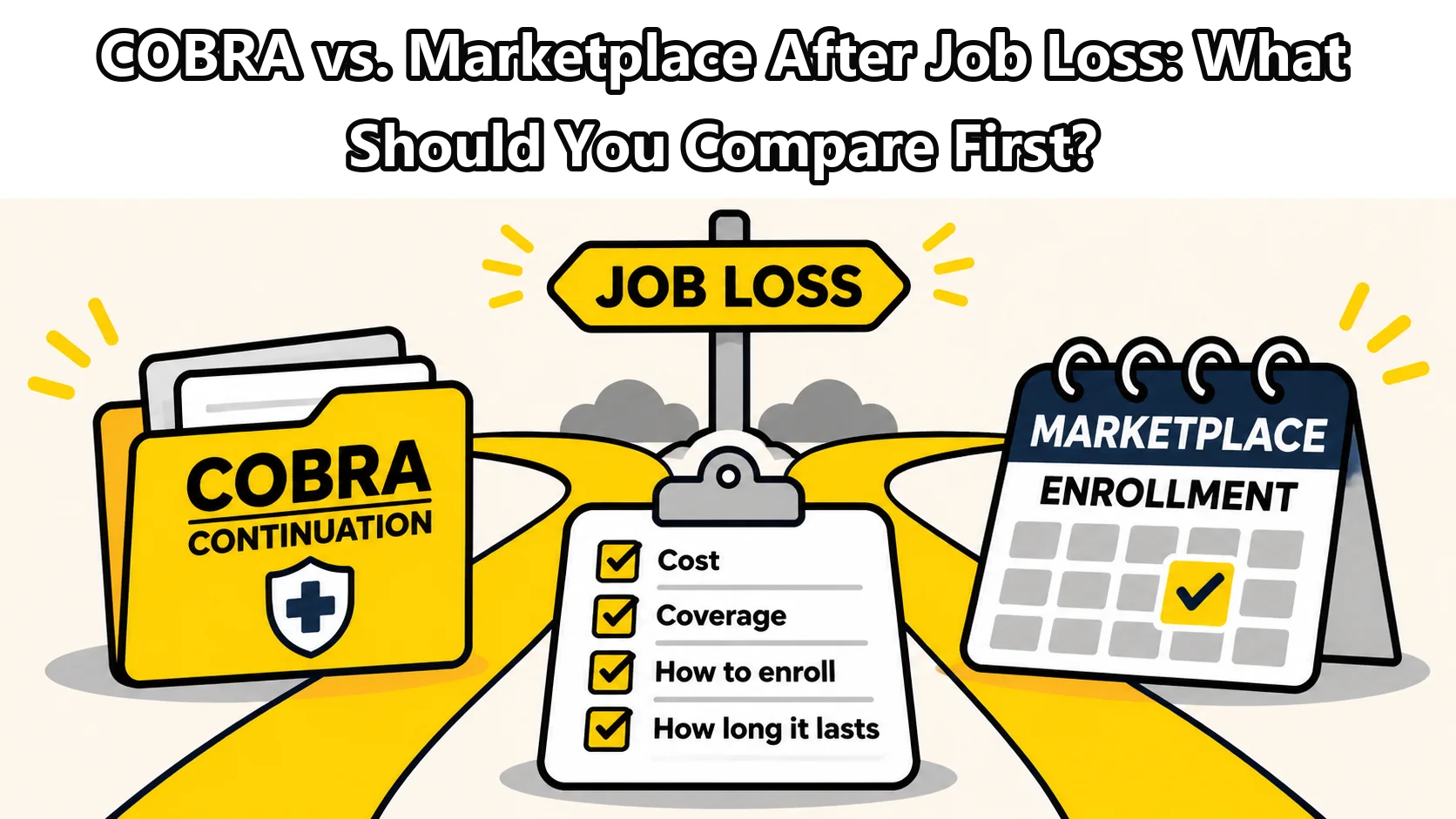
Build the comparison around five facts: the date employer coverage ends, each election deadline, the first possible effective date, and the real monthly and out-of-pocket cost. Do not cancel existing coverage until the replacement start date is confirmed. Keep the official notices and payment records in one dated file.
What COBRA continuation coverage is
COBRA is a federal continuation route that can let eligible workers and their families temporarily keep employer-sponsored group health coverage after certain qualifying events, including job loss or a reduction in hours. The plan is generally the same employer plan rather than a newly selected individual plan. That continuity can matter when a person is in active treatment, has a narrow specialist network or wants to keep the same deductible and prescription rules for the rest of a plan year.
The right to elect COBRA is not a promise that every former employee qualifies. Employer size, plan status, the event, the person’s covered status and the notice all matter. The Department of Labor says the federal rule generally applies to group health plans sponsored by employers with at least 20 employees in the prior year. Read the actual notice instead of relying on a general description.
What Marketplace coverage is
The Health Insurance Marketplace is an individual and family coverage route. Losing job-based health insurance can create a Special Enrollment Period, and HealthCare.gov says a person generally has 60 days to apply. The application can also screen for premium tax credits, other savings, Medicaid or CHIP, depending on household income and eligibility. A state Marketplace may administer the process.
Marketplace coverage is not the same plan as the former employer plan. The insurer, network, formulary, deductible, copay structure and covered services can differ. The application result is not a guarantee that a particular doctor, hospital or medication is covered. Check the plan’s provider directory, Summary of Benefits and Coverage, formulary and effective-date notice before assuming that a service will be available.
Deadlines are different records
The COBRA election deadline and Marketplace enrollment deadline are separate. The Department of Labor says COBRA generally gives a qualified beneficiary 60 days to elect, measured from the later of the date coverage would otherwise end or the date the election notice is provided. HealthCare.gov describes a 60-day Marketplace window after loss of job-based coverage. The dates may be close, but one deadline does not prove compliance with the other.
Create a timeline with the last day of active coverage, notice date, each election deadline, plan-selection date, first premium due date and expected start date. Use the dates stated in official notices. If dates conflict, contact the plan administrator or Marketplace and record the response. Do not infer the deadline from the date a paycheck stopped.
Premium comparison: use the household budget
COBRA commonly shifts the employer contribution to the former employee, so the monthly bill can be materially higher than the payroll deduction that was visible while employed. The DOL describes the usual payment as the full premium plus a small administrative fee, unless an employer agrees to contribute after separation. Add the dental or vision continuation cost if those benefits are being considered separately.
A Marketplace plan can have a lower listed premium after income-based savings, but the application uses estimated household income for the year and the final result depends on the household facts and eligibility. Compare the monthly premium, deductible, copays, coinsurance, out-of-pocket maximum, prescription costs and likely care. Do not compare only the headline premium or assume that a tax credit remains unchanged after a new job, severance, unemployment benefits or a household change.
Network continuity can be the deciding issue
COBRA may retain the employer plan’s network and negotiated rules, which can reduce disruption for a person seeing a specialist, receiving infusions, managing pregnancy care or coordinating an ongoing treatment plan. Continuity still needs confirmation: the employer may change carriers or plan designs, and the provider may leave the network. Ask the plan or provider for current network status rather than relying on an old card.
A Marketplace plan can use a different network design, such as a narrower HMO or EPO arrangement. Check each important doctor, facility, pharmacy and specialty clinic in the current directory. Verify with the provider and insurer, and keep a written record. A hospital’s general acceptance of an insurer does not prove that the chosen Marketplace plan covers every service there.
Deductibles and the plan-year position
When comparing options, ask how much of the current employer plan deductible and out-of-pocket maximum has already been met. COBRA may continue the same plan and therefore may preserve the plan-year structure, subject to the plan’s rules. A new Marketplace plan generally has its own deductible, copays and out-of-pocket accounting. The practical value of continuity can be high when the household has already paid substantial cost sharing.
Request a current accumulator statement from the employer plan and compare it with the new plan’s documents. Do not assume amounts transfer between plans or insurers. If plan years differ, record both. Estimate remaining care from known appointments and prescriptions, but label estimates as estimates. The plan document decides which expenses count.
Effective dates and avoiding a gap
HealthCare.gov says Marketplace coverage after loss of job-based insurance can start on the first day of the month after the old coverage ends, depending on when the person selects a plan and completes required steps. COBRA may provide continuity back to the date coverage ended when elected and paid under the applicable rules. Those mechanics can make the dates look different, so confirm them before declining or ending either option.
Write the exact last day of employer coverage, the COBRA effective date if elected, the Marketplace effective date, the first premium deadline and any document-verification deadline. Ask how a claim occurring between dates will be handled. Never treat an application confirmation as proof that coverage is active. If a Marketplace notice requests proof, submit it through the official channel and keep the confirmation before relying on the plan.
Can you choose COBRA and Marketplace later?
Eligibility for both options does not mean they operate as one combined plan. HealthCare.gov explains that choosing COBRA does not automatically remove every future enrollment path, but the timing and reason for ending COBRA matter. When COBRA expires or is no longer available, a Marketplace Special Enrollment Period may apply. Voluntarily ending COBRA early can be treated differently from an actual expiration or involuntary loss.
Before electing or ending coverage, ask the Marketplace and plan administrator what event would open the next enrollment path and what date controls. Keep the response in writing. Do not cancel COBRA simply because a Marketplace estimate looks cheaper; first verify plan selection, effective date, premium payment and any proof requirement. A new marriage, birth, move or other qualifying event can have its own rules, but it should not be assumed.
Family members may have different choices
A spouse or child may be eligible for a different employer plan, a parent’s plan, Medicaid, CHIP or Marketplace coverage. COBRA can sometimes be elected by covered family members even when the former employee does not elect it. Compare each person’s doctors, prescriptions, eligibility and deadlines instead of treating the household as a single record.
Make a family table with one row per person: current coverage, last covered date, COBRA eligibility, Marketplace status, preferred doctors, medications, premium and effective date. Avoid sending Social Security numbers, medical records or payment information to an information site. Submit sensitive documents only through the verified official channel named in the notice.
Proof of coverage loss and income
The Marketplace may ask for proof that job-based coverage ended or will end. A termination letter, employer benefits statement, coverage certificate or official notice may help, but the Marketplace decides which documents it accepts for the application. The notice may ask for a different document based on the event or household facts.
Income affects Marketplace savings and is usually considered for the full calendar year, not only the months after the job ended. List wages, severance, unemployment benefits and other relevant household income as instructed. Keep the estimate consistent with records. Do not use COBRA’s premium as proof of Marketplace eligibility.
Prescription and treatment continuity
A plan can be affordable and still be impractical if it excludes a needed drug, uses a different tier or requires prior authorization. Compare the employer plan’s formulary with the Marketplace plan’s formulary. Ask the prescriber and insurer about transition supplies, specialty pharmacy rules and refill timing.
For ongoing treatment, ask providers how records, referrals and prior approvals will transfer. Confirm final network status with the insurer. Document the drug, pharmacy, authorization number, expiration date and contact route without publishing medical details. Continuity is a comparison factor, not a guarantee that a claim will be paid.
A neutral comparison worksheet
Use columns for coverage source, plan name, last day of active coverage, election deadline, monthly premium, employer contribution, deductible, out-of-pocket maximum, network, formulary, current accumulator, effective date, first payment, proof required and cancellation rule. Add a source and date for every answer. This makes the decision reviewable if a notice changes.
Separate confirmed facts from estimates. “Doctor appears in directory” is not the same as “insurer confirmed network status,” and “estimated premium” is not the same as a final eligibility notice. Add an open-question column and assign each question to the Marketplace, plan administrator, insurer, provider or qualified professional. Do not let a spreadsheet hide an unanswered deadline.
Questions for the plan administrator
Ask: What is the last day of active coverage? When and how was the COBRA notice sent? What is the exact election deadline? What is the monthly premium and administrative charge? What coverage and dependents can be continued? When will coverage be effective after election and payment? What happens to deductible accumulators, flexible spending arrangements and plan documents?
Request written answers and save the notice, election form, payment instructions and plan description. If the administrator cannot answer a COBRA question, the DOL provides assistance routes. A call-center statement should not replace the notice or plan document.
Questions for the Marketplace
Ask: What loss-of-coverage date is recorded? What is the last day to apply? What documents are required? What is the earliest effective date? What savings or public-program screening applies to the household? When is the first premium due? Can the application be updated if income or employer coverage changes? What happens if proof is rejected?
Save the application ID, eligibility notice, upload confirmation, plan selection, premium invoice and effective-date notice. If a state Marketplace is involved, use the official state route listed in the notice. Do not send identity or payment details through an unverified link.
When a licensed or benefits professional may help
A benefits administrator can explain the employer plan and COBRA mechanics; the Marketplace can explain enrollment and eligibility determinations; an insurer can explain a plan’s network, formulary and claims process. A licensed agent or navigator may help compare Marketplace options where authorized. Each role has a different record and should not be treated as the same source.
Get professional help when the household has active treatment, a complex family-status change, mixed eligibility, a business-owner plan, a retirement transition, a court order or a dispute about a notice. Write down the question and jurisdiction. Insurance Radar explains a comparison method; it does not make the enrollment choice, interpret a plan for a specific person or promise an approval.
Final checklist
Locate the termination notice and current plan documents; record the last day of employer coverage; calculate the COBRA and Marketplace deadlines separately; request the COBRA premium; apply through the Marketplace if appropriate; compare full-year household costs, networks, drugs, deductibles and effective dates; submit requested proof; pay the first premium; and confirm active coverage before cancelling anything.
Keep a dated folder with every notice, application ID, upload receipt, plan document, payment confirmation and call record. Recheck the decision after a new job, changed income, marriage, birth, move, COBRA expiration or plan change. Rules and plan terms can change, and state continuation rules may differ from federal COBRA. Notices and plan documents control.
Sources and further reading
- Welcome to the Health Insurance Marketplace — HealthCare.gov; checked 2026-10-12.