
The short answer
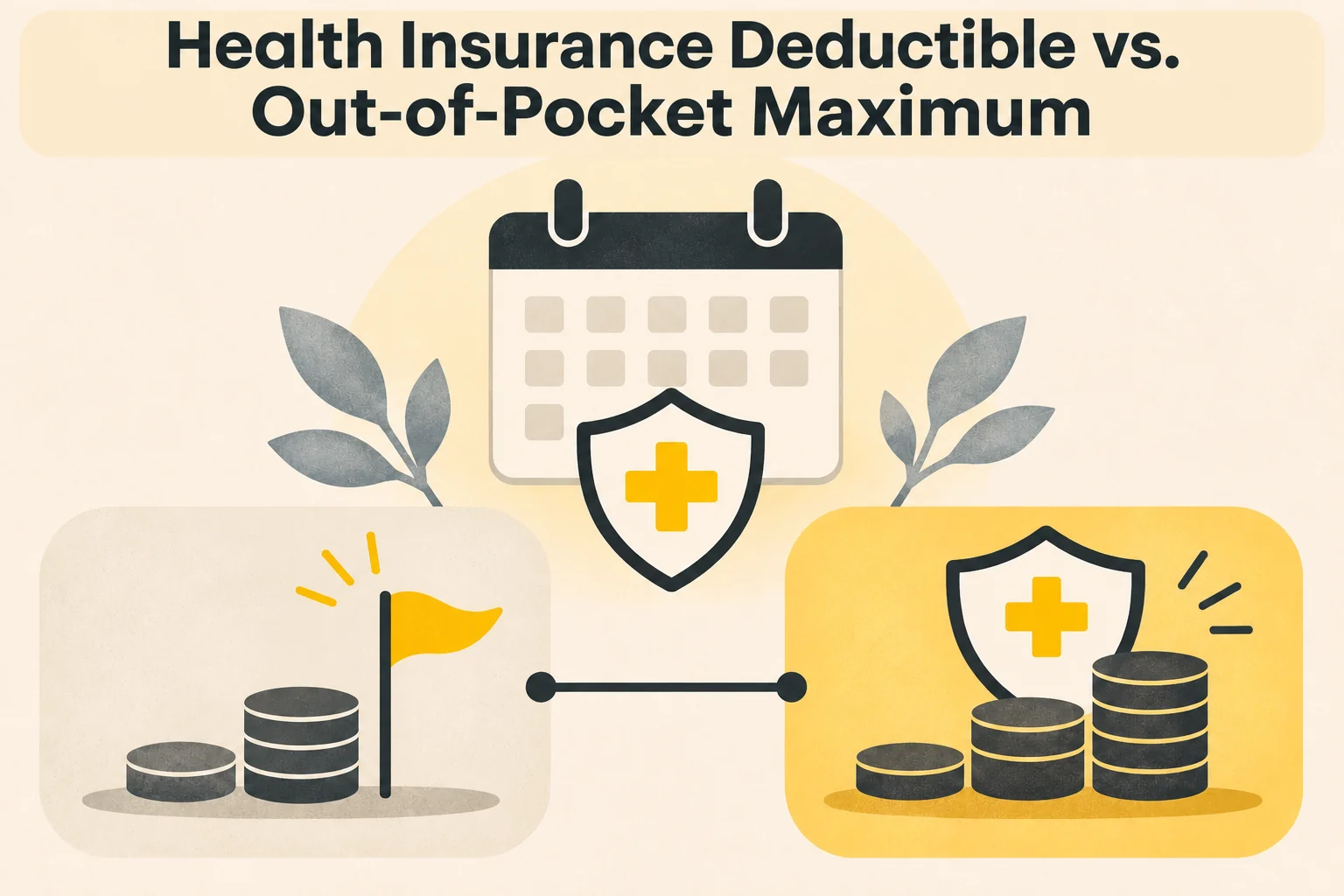
A deductible is the amount a covered person may have to pay for covered services before the plan begins sharing the cost for services that are subject to the deductible. An out-of-pocket maximum is a different limit: it is the plan-year ceiling on the member’s spending for covered, in-network benefits that count toward that limit. After the limit is reached, the plan generally pays the covered, in-network benefits that the contract includes for the rest of the plan year, subject to the plan’s terms.
The two numbers work together, but they answer different questions. The deductible asks, “How much might I pay before cost sharing starts for these services?” The out-of-pocket maximum asks, “What is the most I may have to pay for covered in-network care that counts toward this limit during this plan year?” Neither number alone describes the full financial exposure. Premiums, non-covered care, out-of-network rules, balance billing, prescription tiers, employer contributions, subsidies, and family limits can change the result.
What a deductible does
A deductible is a cost-sharing threshold. If a plan has a deductible, the member may pay the allowed amount for deductible-subject covered services until the deductible is met. The plan may then pay a percentage, a fixed copayment, or another defined amount for later covered services. Some plans apply the deductible to many services, while others pay for specified preventive care or certain office visits before the deductible. The Summary of Benefits and Coverage and the policy or plan document are the places to verify the exact design.
A deductible is not automatically a bill that every member will pay in full. A person who uses little care may pay no deductible-subject expense. Another person may meet it quickly. A service can also have a negotiated in-network rate, a copayment, coinsurance, a prior-authorization rule, or a coverage exclusion that changes what happens. Treat the deductible as a plan rule, not as a prediction of an individual claim.
What an out-of-pocket maximum does
The out-of-pocket maximum is a limit on qualifying member cost sharing during a defined plan year. Depending on the plan and the benefit, payments that may count can include deductibles, copayments, and coinsurance for covered in-network services. The plan document controls what counts and when. Premiums normally do not count toward the out-of-pocket maximum because a premium keeps coverage in force rather than paying a cost-sharing amount for a particular covered service.
Reaching the maximum does not mean every medical bill becomes free. Non-covered services, care outside the plan’s network, amounts above an allowed charge, premiums, and certain excluded or separately administered benefits may not count. A person can therefore reach the plan’s in-network maximum and still have other financial obligations. The practical question is not just the number printed in a comparison table; it is the list of expenses the plan says are included or excluded.
Premiums, deductibles, copays, and coinsurance are separate
The premium is the recurring amount paid to keep coverage active. It can be paid by an individual, an employer, or both, and an eligible Marketplace enrollee may receive financial help under the applicable rules. A deductible is a cost-sharing threshold. A copayment is usually a fixed amount for a defined service or prescription tier. Coinsurance is usually a percentage of the allowed amount after the plan’s rules determine that coinsurance applies. The out-of-pocket maximum limits some qualifying cost sharing, not the premium itself.
When comparing two plans, write down all of these values instead of asking which plan has the “lowest deductible.” A lower deductible can come with a higher premium, a different network, higher coinsurance, a smaller drug benefit, or a different out-of-pocket limit. A higher deductible plan can have a lower premium but require more cash when covered care is used. There is no universal best combination because the relevant risk depends on the person, household, plan year, and expected care.
The deductible may not apply to every service
Plan designs often separate services into categories. A plan may list preventive services, primary-care visits, specialist visits, urgent care, hospital care, mental health care, prescription drugs, laboratory services, and durable medical equipment in different rows. A row may say “before deductible,” “after deductible,” “copay,” “coinsurance,” or “not covered.” Those labels must be read with the network and authorization rules.
A comparison page can make a plan look simple by showing one deductible and one maximum. The actual Summary of Benefits and Coverage may contain important qualifiers, including whether a benefit is subject to a separate prescription deductible, whether a copay applies before the medical deductible, whether the member must use a particular network tier, and whether a referral or authorization is required. Use the official plan document rather than a third-party summary when the numbers affect a real decision.
Individual and family limits are not interchangeable
Family coverage can contain both individual and family cost-sharing limits. The plan may describe how one person’s expenses are treated inside the family deductible, whether a member can reach an individual out-of-pocket limit before the family limit is reached, and which expenses are aggregated. The terms “embedded” and “non-embedded” are sometimes used in plan discussions, but the plan document is more important than the label.
Ask four concrete questions: What is the individual deductible? What is the family deductible? What is the individual out-of-pocket maximum? What is the family out-of-pocket maximum? Then ask whether prescriptions, out-of-network care, or separate benefits follow different limits. A family comparison that only records the family maximum can hide the cash-flow exposure for one member who needs substantial care.
Network status can change the calculation
The same appointment or treatment can produce a different member obligation depending on whether the clinician, facility, laboratory, pharmacy, or other provider is in the plan’s network. In-network care is generally negotiated under the plan’s allowed amount and may count toward the in-network deductible or maximum. Out-of-network care may have a separate deductible and maximum, reduced benefits, no benefit, or exposure to balance billing, depending on the plan and applicable protections.
Before relying on a calculation, verify the network for the actual provider and facility, not just the insurer’s brand. Confirm the plan year, network name, location, service type, referral requirement, prior authorization, and whether the provider is an independent clinician at an in-network facility. A network directory can change and may contain errors, so a current written confirmation and the plan document matter when the treatment is important.
Employer and Marketplace comparisons need different questions
An employer plan and a Marketplace plan can display similar terms but sit inside different enrollment and contribution systems. For an employer plan, compare the employee contribution, employer contribution, eligibility rules, dependents, plan year, waiting period, network, drug list, and Summary of Benefits and Coverage. For a Marketplace plan, review the premium after any applicable financial assistance, the full premium, metal level, network, drug coverage, deductible, out-of-pocket maximum, and enrollment route.
Do not assume that the plan with the lower monthly payroll deduction is cheaper overall. Estimate the annual premium paid by the household, then separately model ordinary care and a high-use scenario using the plan’s cost-sharing rules. Keep employer money and any public financial assistance visible in the worksheet. The site cannot determine eligibility or calculate a person’s subsidy; those questions belong to the official enrollment route and the current application information.
A careful comparison worksheet
Start with two columns and record the exact plan name, issuer or administrator, plan year, network, premium paid by the household, individual deductible, family deductible, individual out-of-pocket maximum, family out-of-pocket maximum, prescription rules, and out-of-network rules. Then add rows for primary care, specialist care, urgent care, emergency care, inpatient care, outpatient procedures, behavioral health, laboratory services, imaging, prescriptions, and preventive care. Copy the wording, not just your interpretation of it.
Run at least two scenarios. In the ordinary-use scenario, list the services the household expects and apply the stated copays, deductibles, coinsurance, and allowed amounts. In the high-use scenario, test what happens if one person has a major covered in-network episode. Do not treat the result as a promise: the plan may require authorization, use different tiers, exclude a service, or apply a rule that the worksheet does not model. The tool on this site is an educational organizer, not a quote or coverage determination.
When a bill does not match your expectation
A bill that looks inconsistent with the deductible or maximum deserves a document-based review, not an assumption that the insurer is wrong. Compare the provider bill with the insurer’s Explanation of Benefits, the claim’s allowed amount, the network status, the service codes, the amount applied to deductible, the amount applied to coinsurance or copay, and any denial or authorization message. Check whether the claim belongs to the current plan year and whether a separate benefit or pharmacy administrator is involved.
Write down the question and ask the insurer or plan administrator for the specific plan provision and calculation. If the issue is a provider billing problem, ask the provider to review the claim against the Explanation of Benefits. If an internal appeal, complaint, external review, employer benefits office, or state regulator may be relevant, use the route that applies to the type of plan and jurisdiction. Keep records of dates, documents, reference numbers, and responses, but do not submit sensitive medical or policy data to this site.
Why an online example does not decide your plan
Public discussions can reveal the questions people struggle with: why a deductible and maximum coexist, why an employer plan looks different from a Marketplace plan, or why a bill did not match a simple estimate. They cannot establish the terms of another person’s plan, the accuracy of a personal account, or the result for your claim. Two plans can use the same insurer brand and have different networks, administrators, plan years, employers, and documents.
Use a public question to identify what to verify, then return to the official Summary of Benefits and Coverage, Evidence of Coverage, certificate, member handbook, prescription formulary, network information, and Explanation of Benefits. The policy and plan documents control. A general article can help you ask a better question; it cannot replace the document that governs the benefit.
Questions to ask before choosing or using a plan
Ask: Which services are covered before the deductible? Which deductible applies to prescriptions? What is the allowed amount for the service? Which providers and facilities are in network? Are there separate individual and family limits? Which expenses do not count toward the out-of-pocket maximum? What happens after the maximum is reached? When does the plan year reset? What authorization, referral, or documentation rules apply? How are denied claims appealed?
Finally, ask who is responsible for the answer. An insurer, employer benefits office, Marketplace, plan administrator, provider, pharmacy benefit manager, state regulator, and federal program can have different roles. Record the name of the source, the date, the plan year, and the exact document. That simple discipline is more reliable than comparing a single headline number or treating a high-voted online comment as a plan rule.
A practical record checklist
Use the current document about How do a health insurance deductible and out-of-pocket maximum differ? as the starting point and write the exact question before contacting the responsible provider. Record the policy or plan name, the people involved, the location, the effective date and the date on which the question arose. Separate a confirmed fact from an estimate, a public example and a conclusion that still needs a written answer. Keep notices, declarations, invoices, receipts, photographs, estimates, applications and correspondence in one dated file.
Questions to resolve before acting
Write the missing fact, the responsible contact and the next deadline before choosing a response.
A dated follow-up plan
Keep the notice, the answer, the date and the reference number together so the next step can be checked.
When formal help may be useful
Use an official agency, carrier, administrator or licensed professional when the record remains unclear.
What to preserve afterward
Save the final document and note what changed, what remains open and when the question should be reviewed again.
Sources and further reading
- Welcome to the Health Insurance Marketplace — HealthCare.gov; checked 2026-10-12.
- Consumer insurance information — National Association of Insurance Commissioners; checked 2026-10-12.
- Centers for Medicare & Medicaid Services — CMS; checked 2026-10-12.