
The short answer
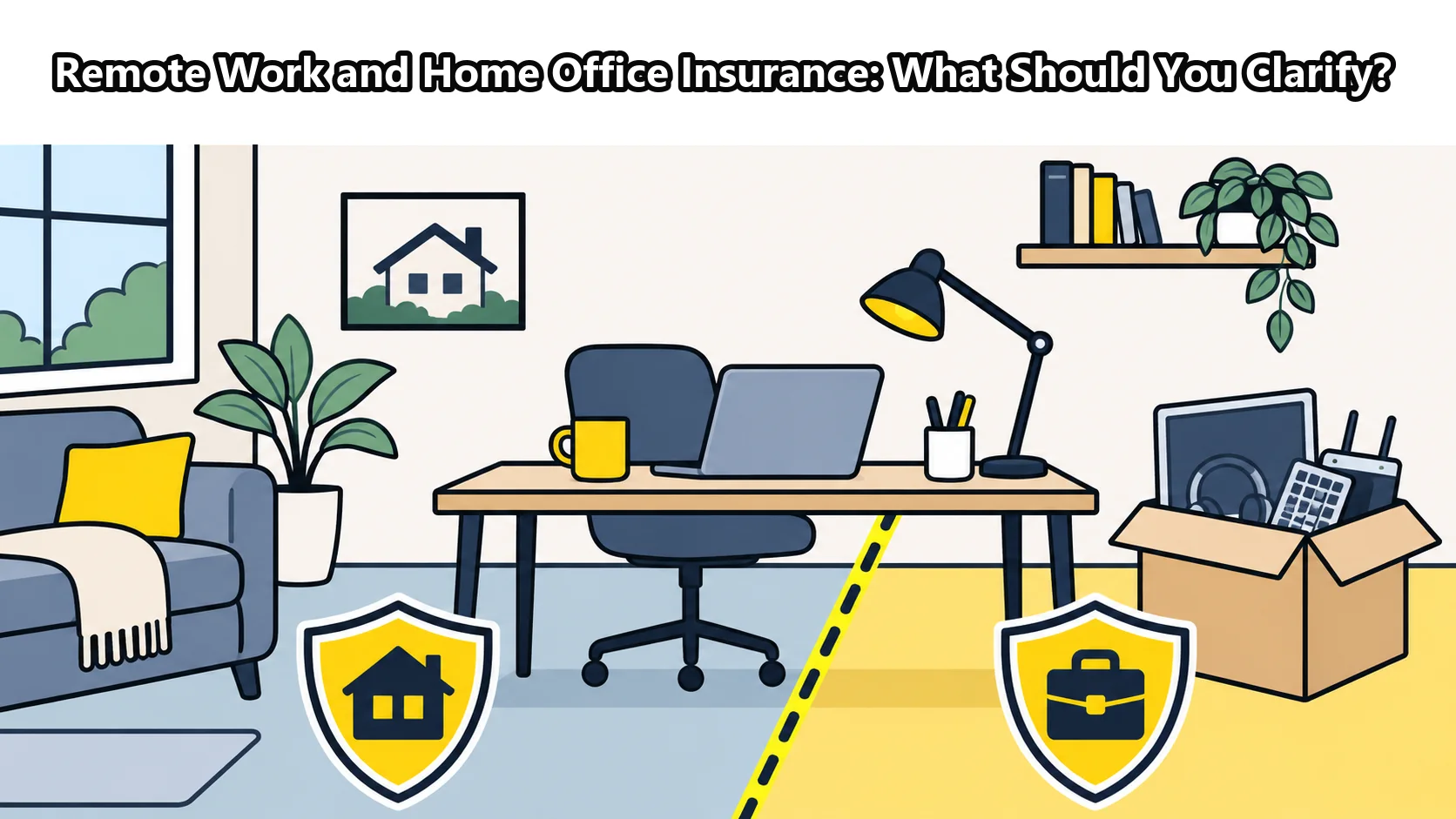
Working from home can create two different situations. You may be an employee using a home office for an employer, or you may operate your own business from a residence. The insurance questions are not identical. NAIC explains that a personal homeowners or renters policy may not be designed for the unique needs of a home-based business, and that business property, professional liability and commercial activity can require separate review.
Start by describing the activity, not by choosing a policy name. Write down who owns the equipment, who controls the data, whether clients visit, whether products are stored or shipped, whether anyone is paid to help, whether a vehicle is used for work and whether income depends on the home remaining usable. Then ask the employer, insurer, agent or state regulator which policy or endorsement applies. Do not assume a laptop, a spare room or a remote-work arrangement is automatically covered.
Employee telework is different from a home business
An employee who works remotely may use employer-owned equipment, access employer data and perform the same job away from the office. NAIC advises telecommuters to ask about employer workers’ compensation and to verify how company security software protects information on a home computer. The employer’s policies, handbook and reporting process matter alongside personal home insurance.
Ask who owns the laptop, monitors, samples and furniture; who repairs them; how a theft or accidental damage is reported; whether a visitor or delivery person is covered; and how a work-related injury is handled. A home policy may respond to a personal loss while the employer has a separate responsibility for business property or data. Get the process in writing rather than promising that one policy will answer every question.
A home-based business changes the risk profile
A business operated from a home can involve customers, suppliers, inventory, professional advice, cash, records, deliveries and third-party visitors. NAIC warns that failing to disclose a substantial home business can lead to a denied business-related claim or a nonrenewal. The fact that the business is small, online or part-time does not by itself decide the insurance treatment.
Describe the work, revenue model, property, services and visitors accurately. A consultant, online seller, tutor, repair worker, caregiver and content creator can each have different risks. Ask whether a homeowners or renters endorsement is available, whether a business owners policy is appropriate or whether a standalone commercial policy is needed.
Inventory and equipment
Make a separate inventory for personal property and business property. List laptops, monitors, cameras, tools, samples, stock, packaging, printers, furniture, backup drives and specialized equipment. Record owner, location, serial number, approximate value, purchase date and whether the item travels. Keep receipts and photographs privately.
A standard home policy may have special limits or exclusions for business property. The limit may differ when equipment is at home, away from home, in a vehicle or at a client location. Ask whether replacement cost, actual cash value, scheduled property, transit, theft and accidental damage are available. Do not treat an inventory as proof that every listed item is insured.
Professional services and advice
A remote business may sell advice, design, software, coaching, accounting, health-related services, legal services or other professional work. NAIC notes that professional liability is not included in standard homeowners or renters insurance. A general liability policy is not automatically a substitute for errors and omissions or another professional form.
Map the promise made to the customer and the possible loss if the work is alleged to be wrong, late or incomplete. Ask what policy addresses professional negligence, contractual liability, media, intellectual property or client data. Do not describe a policy as covering an activity unless the form or written carrier response supports that conclusion.
Client and visitor injuries
A home office can receive a client, contractor, courier, student, patient or customer. A slip, fall, animal incident or property-damage allegation raises a premises and business-liability question. The personal policy, a home-business endorsement, a commercial policy and a lease may each use different definitions and exclusions.
Tell the insurer how often people visit, where meetings occur and whether the space is shared with the household. Ask about parking, stairs, pets, equipment, minors and accessibility. If client meetings are prohibited by a lease, HOA rule or local requirement, solve that operational issue instead of assuming insurance makes the activity acceptable.
Business interruption and the home itself
A home-based business can lose income if the residence, equipment, internet, utilities or a key supplier becomes unavailable. A homeowners policy’s additional living expense benefit is not the same as business income coverage. NAIC describes business owners policies as packages that typically include property, business interruption or continuation and liability insurance, but the actual form and eligibility control.
Ask what event triggers business-income coverage, what expenses qualify, whether extra expense is included, what waiting period applies and whether the business must keep records. Separate a damaged home from a cyber outage, a supplier shutdown, a government closure and a loss of demand; these events may be treated differently.
Workers’ compensation and helpers
If anyone helps the business, classify the relationship before assuming that an independent-contractor label settles the question. NAIC notes that many states require workers’ compensation for employees, with exceptions and definitions that vary, and that an injured worker can create expense and liability concerns when required coverage is absent.
Ask the state workers’ compensation authority, insurer or qualified professional how the rules apply to a spouse, family member, part-time assistant, contractor, domestic worker or unpaid helper. Record payroll, duties, location and supervision. Do not use a personal health plan, disability policy or homeowners policy as a substitute for a required workers’ compensation program.
Cybersecurity and company information
Remote work can expose customer information, employer records, payment data and credentials through a home network, shared device, lost laptop or phishing event. NAIC advises telecommuters to verify necessary security software and recognize responsibility for protecting company information. Whether a loss is covered depends on contracts, employer policies and insurance forms.
Use the employer’s approved device and security process when available. Ask who reports an incident, who preserves evidence, whether a personal device is allowed and whether cyber insurance or a technology errors-and-omissions policy is relevant to a business. Do not upload confidential client or employer data to an insurance comparison form.
Auto, deliveries and business use
A remote business may still use a car to deliver products, visit clients, collect supplies or transport people. Personal auto insurance may treat business use differently from commuting or ordinary errands. NAIC small-business guidance notes that commercial auto can include higher liability limits and provisions for rented or non-owned vehicles, but the actual use and policy wording control.
List who drives, which vehicle is used, where it is garaged, what is transported and whether another person’s car is used. Ask about personal, business, hired and non-owned auto. Never assume that a customer delivery, paid passenger, ride-share activity or employee-owned car has the same coverage as a personal commute.
Inventory, shipping and home sharing
Online sellers and home-based operators can have stock at the residence, in transit, at a marketplace warehouse or at a customer location. A personal policy may not cover inventory or a business shipment in the same way as personal belongings. Home-sharing and rental activity can also change how a carrier defines business use.
Map the custody chain from purchase to delivery and keep order, shipment and loss records. Ask about stock, spoilage, transit, customer property, returns and platform terms. If part of the home is rented or listed, disclose the frequency and arrangement; NAIC warns that regular home-sharing may be treated as a home-based business even when an exclusion is not obvious.
Lease, HOA and local rules
Insurance cannot override a lease, condominium declaration, HOA rule, zoning limit, professional license or permit. A landlord may restrict customer visits, inventory, signage or alterations. An HOA may have rules about commercial activity or shared areas. A business policy can cover a loss while the activity still violates a separate agreement.
Read the lease and governing documents before buying coverage. Identify who must be named as an additional interest, who maintains the building, what repairs are permitted and how a claim is reported. If the business requires a certificate of insurance, make sure the certificate describes existing coverage rather than promising a policy condition that is not actually issued.
Business owners policy versus endorsement
A home-business endorsement may be suitable for limited activities, while a BOP or standalone commercial policy may be considered as the operation grows. NAIC describes a BOP as a package that typically combines property, business interruption or continuation and liability. The package label does not guarantee professional, cyber, commercial auto, workers’ compensation or every business risk.
Compare the policy’s property, liability, income, exclusions, deductibles, territory, claims reporting and eligibility. Ask what happens when revenue, employees, locations, inventory or services change. A cheaper-looking package with a missing coverage can be a worse fit than a narrower endorsement that is accurately matched to the actual activity.
State differences and licensed advice
Workers’ compensation, business licensing, home-occupation rules, insurer forms and complaint routes can vary by state. A national checklist can identify questions but cannot tell a remote worker whether a particular activity is licensed, permitted or insured in a jurisdiction.
Use the state insurance department, workers’ compensation authority and business agency for current rules. Ask a licensed insurance professional about the policy form and a qualified adviser about tax, employment or licensing issues. Keep the source, date and jurisdiction with every answer because a web page from another state may not apply.
A neutral home-office coverage worksheet
Create columns for activity, owner, people involved, equipment, data, visitors, inventory, vehicle use, property location, revenue dependency, contract, existing policy, exclusion, deductible and unresolved question. Add the insurer, policy period, limit, endorsement number and claims contact for each policy.
Mark each answer as confirmed by a policy, endorsement, employer document, lease, written carrier response or state agency. Do not fill a blank with an assumption. Review the worksheet after a new client, product, employee, location, vehicle, lease, device or service is added.
Questions to ask before relying on existing coverage
Ask: Is the home business disclosed? Which business property is covered and at what limit? Are client visits, inventory, professional services, deliveries, business auto, cyber events and helpers addressed? Who owns and repairs employer equipment? How are work injuries reported? What does the lease or HOA allow? Which state agency controls a workers’ compensation or licensing question?
Request written answers in the terminology of the policy. If a carrier says an endorsement is needed, obtain the form or quote and verify the effective date. If the employer supplies equipment or data, follow its reporting and security instructions. A verbal “you should be fine” is not a policy grant.
Final checklist
Before relying on coverage, separate employee telework from business activity; disclose the home office; inventory equipment and stock; map client and delivery exposure; ask about professional liability; confirm workers’ compensation classification; review cyber and auto use; read lease or HOA rules; compare endorsement, BOP and commercial options; and save the current policy and written answers.
Review after a new service, customer, helper, product, vehicle, device, address, lease or revenue change. Insurance Radar explains the questions; the employer, insurer, state agency, policy wording and qualified professionals determine the actual result. Do not place confidential employer, client, health, payment or identity records in a public form just to obtain a general explanation.
Sources and further reading
- Consumer insurance information — National Association of Insurance Commissioners; checked 2026-10-12.