
The short answer
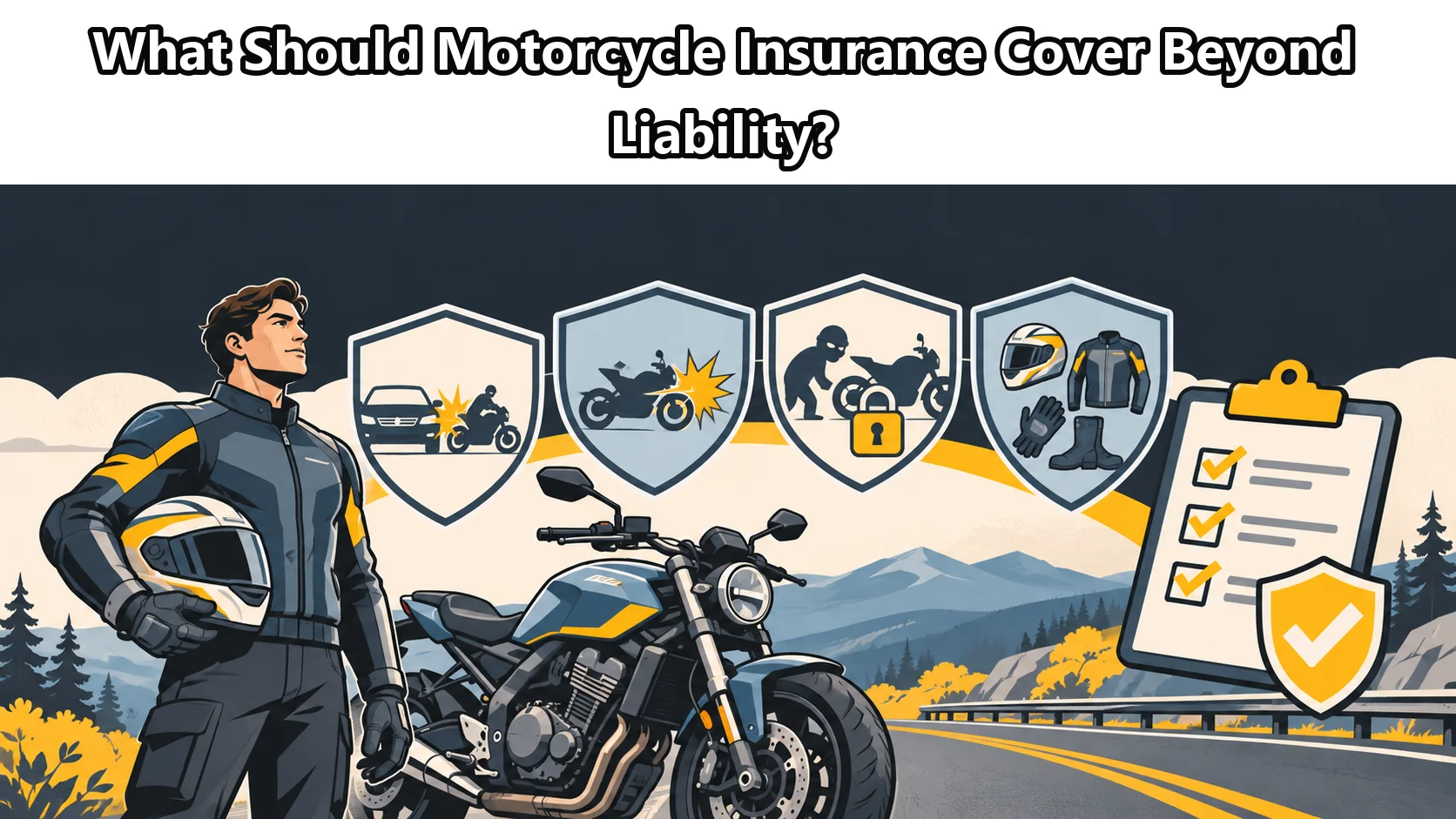
Liability is only one part of a motorcycle policy. Compare collision for crash damage, comprehensive for theft or weather, uninsured or underinsured motorist protection, medical benefits, and coverage for gear, accessories, custom parts, trailers, and roadside service. No label guarantees payment; limits, deductibles, exclusions, state form, and policy definitions decide what the contract does.
Start with the loss you could not comfortably absorb. If the motorcycle is financed, ask the lender what physical-damage coverage is required. If the bike is older, compare premium and deductible with its replacement value. Check for a separate limit on expensive gear or custom parts. Compare exposures and contract terms, not a universal “full coverage” package.
Separate liability from protection for your own bike
Liability coverage generally addresses covered injury or property damage for which the insured is legally responsible, subject to limits and exclusions. It does not automatically pay to repair the insured motorcycle after an at-fault crash, and it does not replace the rider’s health or disability coverage. State minimums can be too small for a serious injury or a modern vehicle, but the required amount varies by jurisdiction.
Physical-damage coverage is a first-party question: what happens to the listed motorcycle after a covered loss? Ask whether the policy covers only the motorcycle shown on the declarations, whether a temporary substitute is treated differently, and whether modifications must be disclosed. Keep the two questions separate so a low liability price does not create a false impression that the bike itself is protected.
Understand collision coverage
Collision coverage is commonly associated with damage caused by striking another vehicle or object, or by a rollover or loss of control. A low-speed drop may still be treated as collision under the policy even when no other vehicle is involved. The definition, deductible, valuation method, and repair or total-loss rules are more important than the marketing label.
Ask for the collision deductible and a realistic example using the motorcycle’s current value. Compare the cost of a small repair with the amount you would pay before insurance contributes, then consider a severe crash or total loss. If the bike is financed, verify that the lender’s requirements and the policy’s deductible are compatible. Never assume a motorcycle policy covers collision damage to a separate car.
Understand comprehensive coverage
Comprehensive coverage generally addresses specified non-collision risks such as theft, fire, vandalism, falling objects, or weather, depending on the policy. A stolen motorcycle and a motorcycle damaged while parked may travel through this coverage rather than collision. The exact covered causes and exclusions must be read in the policy form.
Compare the comprehensive deductible with the bike’s value and the theft risk where it is stored. Ask whether keys, security devices, recovery costs, personal property, and transport are treated as part of the motorcycle loss or as separate benefits. Removing comprehensive during a storage period may reduce cost, but it can also remove theft or weather protection; ask the carrier about a permitted lay-up or storage arrangement instead of guessing.
Check how the motorcycle is valued
A total-loss payment is not automatically the amount the rider paid for the motorcycle. The policy may use actual cash value, an agreed or stated amount, a replacement-cost feature, or another valuation method. Depreciation, mileage, condition, comparable vehicles, taxes, fees, salvage, and the deductible can affect the result. Public examples are not a promise about a specific claim.
Ask the carrier to explain the valuation method and whether accessories or custom equipment are included. Keep the purchase documents, photographs, service records, receipts, and secure-storage information. If the motorcycle is rare, restored, collectible, or heavily modified, ordinary market comparisons may not describe its value, so the policy form and any endorsement deserve special attention before a loss.
Compare uninsured and underinsured motorist protection
An uninsured or underinsured motorist claim can arise when another driver is responsible but has no insurance or not enough liability insurance. The coverage may address bodily injury and, in some jurisdictions or forms, property damage. Whether it is required, offered, rejected in writing, or subject to special rules depends on state law and the contract.
Ask whether the limits match the rider’s exposure and whether the coverage follows the person, the motorcycle, or both. Confirm stacking, hit-and-run rules, notice deadlines, medical documentation, and how a settlement with the responsible driver affects the claim. Do not assume that the other driver’s liability limit or the motorcycle’s physical-damage coverage solves an injury claim.
Review medical payments and personal-injury benefits
Motorcycle crashes create bodily-injury exposure even when the motorcycle damage is modest. Medical payments, personal-injury protection, health insurance, disability coverage, and other benefits can interact differently by state and policy. Some products may offer a medical-payment limit while others use a state-specific personal-injury structure. The label alone does not show who pays first or what is excluded.
Ask what the benefit covers, who is insured, whether passengers are included, how coordination with health coverage works, and whether there are time or treatment limits. Check the rider’s health, disability, and emergency savings separately. This article cannot decide whether a limit is adequate; a licensed professional and the applicable policy documents are needed for a personal recommendation.
Do not overlook helmets, clothing, and riding gear
A helmet, jacket, boots, gloves, communication device, luggage, and protective equipment may be treated as personal property, motorcycle equipment, or a separate optional benefit. A policy may provide no coverage, a small sublimit, a deductible, depreciation, or a requirement that the item be listed. Comprehensive coverage does not automatically mean every item on the rider is included.
Make an inventory with photographs, model names, purchase dates, and receipts. Ask whether gear is covered after a crash, theft, or only a particular type of loss, and whether the limit is per item or per occurrence. If the rider carries expensive equipment, compare the specific endorsement with any homeowners or renters policy rather than assuming one policy will coordinate automatically.
List accessories, custom parts, and improvements
Crash bars, upgraded suspension, exhaust, navigation equipment, luggage, paint, lighting, audio, and custom controls can change the motorcycle’s repair cost and value. A base motorcycle limit may not include every improvement, or an endorsement may require invoices and a declared amount. Some modifications can also affect underwriting or eligibility.
Tell the insurer what has been added and keep a dated parts list. Ask whether the amount is included in the motorcycle’s stated value, subject to a separate equipment limit, or excluded unless scheduled. Do not inflate a claim or substitute a different part without disclosure. Accurate records make it easier to distinguish factory equipment, permanent accessories, detachable gear, and personal property.
Ask about passengers, permissive use, and storage
A motorcycle may be used by an owner, household member, guest, learner, or occasional rider. The driver list, licensing, training, garaging address, use, and permissive-use wording can affect eligibility and claims. A friend borrowing the bike may not create the same coverage result as a listed household rider, and a passenger’s injury can raise separate questions.
Tell the carrier how the motorcycle is actually used: commuting, touring, delivery, events, training, off-road riding, or seasonal recreation. Confirm whether a trailer, transport, storage facility, or address change must be reported. A policy written for one use or state should not be treated as universal after a move, a new rider, or a change in the motorcycle’s principal location.
Treat deductibles as part of the coverage decision
A deductible is the amount the policyholder may bear before a covered first-party payment, subject to the contract. Collision and comprehensive can have different deductibles, and a claim involving several coverage parts may not be reduced in the way a simple online example suggests. A deductible does not answer liability or determine whether a loss is covered.
Choose a deductible only after checking emergency savings and the bike’s value. Request a quote comparison that changes one variable at a time, then read whether the amount applies per incident, per item, or under a special endorsement. A higher deductible may lower a premium, but the apparent saving is not useful if the rider could not fund the first repair or theft-related expense.
Consider roadside, towing, and temporary transportation
Roadside assistance may cover towing, battery service, fuel delivery, flat-tire help, or lockout assistance, but motorcycle eligibility, distance limits, event limits, and reimbursement rules differ. A roadside feature is not the same as coverage for mechanical failure, a damaged part, or transportation after a covered claim.
Ask whether the service applies to the motorcycle and trailer, whether a preferred provider must be used, and whether the benefit has a per-event or annual limit. If a crash leaves the rider without transportation, ask whether rental or trip-interruption benefits exist and whether a motorcycle rental is actually available. Do not count a roadside number as a promise of claim payment.
Account for seasonal use and lay-up
A motorcycle kept in storage may have a different risk profile from one ridden daily, but “seasonal” does not automatically mean that every coverage can be paused. Theft, fire, weather, falling objects, and liability while moving or testing the bike may remain relevant. A lender may also require continuous physical-damage coverage.
Ask the insurer for the permitted storage or lay-up treatment in the applicable state and policy. Confirm effective dates before reducing or restoring coverage, and record where the motorcycle is garaged. Never ride while assuming a reduced-storage arrangement provides the same liability or collision protection as an active policy.
Prepare a motorcycle claim file before a loss
Keep the declarations page, policy form, endorsements, VIN, title or finance documents, photographs, maintenance history, parts invoices, gear inventory, security information, and emergency contacts together. After a crash or theft, record the date, location, people involved, police or incident number, photographs, witness details, and steps taken to prevent further damage.
Report the loss through the carrier’s stated route and follow instructions about inspection, storage, repairs, salvage, and evidence. Do not authorize a major repair, dispose of damaged gear, or sign a release before understanding what the adjuster needs. A claim decision depends on the policy, facts, evidence, limits, exclusions, and applicable law; this guide cannot predict the result.
Compare policy wording, not just the package name
“Full coverage,” “comprehensive,” “custom,” and “protection package” are not uniform legal terms. Compare the declarations page, definitions, exclusions, conditions, endorsements, limits, deductibles, valuation clauses, claim duties, cancellation rules, renewal treatment, and state notices. Two services can use the same everyday label with materially different forms.
Make a side-by-side table and mark each item as included, optional, excluded, unknown, or subject to a separate limit. Verify the named insurer and the state-specific form. Public product pages can explain categories and routes, but the issued contract and declarations control the coverage actually purchased.
Use the state and lender context
Motorcycle insurance requirements are state-specific. Financial-responsibility rules, uninsured-motorist options, medical benefits, helmet laws, filing requirements, cancellation notices, and producer or insurer rules can change the practical choice. A national summary is not a substitute for the insurance department or the policy form in the rider’s state.
If a lender, lease, event, employer, or storage facility requires proof of insurance, ask for the exact limit and wording rather than accepting a vague package name. Recheck the policy after a move, title change, financing change, modification, new rider, or significant use change. Keep the evidence used for the decision current.
Final checklist
Before buying or changing motorcycle insurance, confirm liability limits, collision, comprehensive, valuation, deductibles, uninsured or underinsured motorist protection, medical benefits, passenger rules, gear, accessories, custom parts, roadside service, storage treatment, usage reporting, lender requirements, state availability, exclusions, and claim instructions.
Then compare the total cost with the loss you could absorb and request the controlling wording in writing. Do not rely on “full coverage” as a legal definition, a social-media answer, or an online quote summary. The useful policy is the one whose limits, exclusions, conditions, and state form match the motorcycle, rider, use, and financial risk you actually have.
Sources and further reading
- motorcycle insurance public reference — motorcycle insurance; checked 2026-10-13.
- Motorcycle Insurance — GEICO; checked 2026-10-15.
- Types of Motorcycle Insurance Coverage — Dairyland Insurance; checked 2026-10-15.
- Motorcycle Insurance Claims — Dairyland Insurance; checked 2026-10-15.
- Pay Per Mile Motorcycle Insurance — VOOM Insurance; checked 2026-10-15.
- VOOM Motorcycle Insurance FAQs — VOOM Insurance; checked 2026-10-15.