
The short answer
Do not judge employer disability insurance by the percentage shown in an enrollment screen alone. Compare the plan document, the definition of disability, the waiting period, the benefit period, offsets, taxes, exclusions, claim duties, and what happens when employment ends. Employer coverage can be valuable, but it may be limited by salary caps, a less favorable occupation definition, a maximum benefit period, or a requirement to remain employed.
Start by collecting the certificate, summary plan description, enrollment confirmation, payroll deductions, employer contribution information, and any individual policy illustration or contract. Build a side-by-side comparison using the words in the actual documents. Marketing pages can explain a provider’s product category, but they do not replace the contract or establish what will happen to a particular claim.
Identify who owns and administers the coverage
Ask whether the employer plan is group insurance, an employer-funded arrangement, or another benefit structure, and identify the insurer, plan administrator, claims contact, and document that controls. The employer’s benefits portal may show a simplified summary while the certificate or summary plan description contains the operative details. Find the plan year, eligibility class, enrollment date, and any evidence-of-insurability requirement.
Record whether you pay the premium, whether the employer pays it, and whether you can change the election during open enrollment or after a qualifying event. Those facts can affect take-home value, taxation, and access to coverage. Do not assume that an employer label such as “LTD” tells you the definition, duration, or portability of the benefit.
Separate short-term and long-term disability
Short-term disability, or STD, is usually designed for an earlier period after a disabling condition, while long-term disability, or LTD, may begin after a longer elimination period. The exact durations, benefit percentages, maximums, and claim requirements vary by plan. Some employers offer one, both, or neither. State programs and leave laws may also interact with a private or employer benefit, but they are separate questions.
Map the handoff from paid leave or STD to LTD. Ask who decides the claim, when proof is due, whether benefits are paid for partial work, and what happens if the condition improves and later returns. A plan that looks adequate for the first months may leave a longer income gap if LTD begins late or ends after a limited period.
Read the definition of disability
The definition may ask whether you can perform your own occupation, your own occupation with material duties, any occupation for which you are reasonably suited, or another standard described in the plan. Some policies use one definition for an initial period and a stricter definition later. A job title is not the same as the duties, physical demands, cognitive demands, schedule, and income used by the policy.
Ask for the exact definition and the date on which it changes. Check how the plan treats partial disability, residual income loss, rehabilitation, work attempts, and the ability to perform another job. Do not infer that a medical diagnosis automatically satisfies the contractual definition; the claim decision depends on the policy language, evidence, and applicable process.
Compare own-occupation and any-occupation language
Own-occupation language can be important for specialized work, but the phrase may be qualified by a requirement to be unable to work elsewhere or by an earnings test. Any-occupation language generally asks a broader work-capacity question, often after a specified period. The wording, transition point, and treatment of work income matter more than the label used in a brochure.
Write down the occupations the plan considers, the evidence used to evaluate them, and whether the insurer can require vocational information. For a physician, contractor, pilot, business owner, or other specialized worker, compare the duties and training assumptions carefully. This is a comparison question, not a prediction of a claim outcome.
Check the elimination period and benefit period
The elimination period is the time that must pass before benefits begin if the claim otherwise qualifies. It may be measured from the date of disability, may have conditions about continuous disability, and may interact with STD, paid leave, or a second disabling event. The benefit period is the maximum duration under the contract and may differ by age, condition, or definition of disability.
Create a timeline showing the last day worked, the start of disability, notice, medical evidence, the elimination period, expected first payment, and the maximum benefit date. Ask what happens during gaps in employment or when a person returns to work part time. A longer waiting period may reduce premium in an individual policy, but it also requires a larger emergency reserve.
Calculate the benefit amount and offsets
A plan may promise a percentage of covered earnings subject to a monthly maximum. Covered earnings can be defined by salary, base pay, bonuses, commissions, or another formula. Individual policies may use their own income limits and may consider other coverage when determining an allowable amount. Compare the actual dollar maximum, not only the percentage.
List offsets and reductions such as Social Security disability benefits, workers’ compensation, other group benefits, retirement income, sick pay, or earnings. The plan may require an application for another benefit or may reduce its payment after another benefit is approved. Ask how an offset is calculated if the other program denies, delays, reduces, or later changes its payment. Do not assume that two policies stack to the sum of their advertised amounts.
Review taxes and take-home value
The tax treatment of disability benefits can depend on who paid the premium, whether the premium was paid with after-tax or pre-tax money, the plan structure, and the governing rules. A payroll deduction is not enough to determine the tax result. Compare the stated benefit with a conservative after-tax estimate and note which assumptions need confirmation from payroll, the plan administrator, or a qualified tax professional.
Record premiums, employer contributions, tax elections, benefit amounts, and any required reporting. If you change jobs, the tax treatment or availability of the employer benefit can change with the new plan. Avoid presenting a tax estimate as a guarantee; the contract and current tax rules control.
Look for exclusions, limitations, and pre-existing-condition rules
Read exclusions and limitations for specific conditions, self-inflicted injury, substance use, war, criminal activity, work-related injuries, foreign residence, and other categories stated in the contract. A group plan and an individual policy may use different evidence, exclusions, and pre-existing-condition wording. Some individual applications involve medical underwriting or an exclusion rider; an employer enrollment window may use different rules.
Mark every limitation that could affect your work, travel, side business, treatment, or planned job change. Ask for the definition of a pre-existing condition, the look-back period, contestability or proof requirements, and whether a limitation applies only to an initial claim or to later claims. Do not assume that a condition mentioned in an application is automatically excluded or automatically covered.
Check portability and job-change risk
Employer coverage may end when employment ends, when eligibility changes, or when the employer changes carriers. Some plans allow conversion or portability, while others do not or impose time limits, new pricing, or different terms. Confirm whether coverage continues during leave, severance, disability, or a transition between employers.
Ask for the exact notice and election deadline and keep the continuation materials. Compare the new employer plan before cancelling individual coverage. An individual policy can be independent of one employer, but premiums, underwriting, benefit design, and state availability must be reviewed. Never treat a verbal statement from HR as the final portability rule when the certificate gives a different process.
Understand plan documents and ERISA context
An employer disability benefit may be governed by a plan document and a summary plan description, and the process for requesting records, appealing a decision, or bringing a dispute can depend on the arrangement. ERISA questions are fact-specific and are not answered by the label on a benefits portal. A government program such as Social Security Disability Insurance is a separate program with its own eligibility standard and application path.
Keep the version of the plan document in effect when coverage began and any later amendments. Note the claims and appeals section, deadlines, required evidence, decision notices, and address for submissions. This guide does not provide legal advice; when the issue involves a denied claim, litigation deadline, or disputed plan interpretation, obtain qualified advice for the relevant state and plan.
Prepare for claims and medical evidence
A claim may require notice, an employer statement, attending-provider records, functional limitations, earnings information, job duties, and continuing proof. The insurer may request forms from more than one party and may set deadlines for updates. The exact package depends on the plan and the claim facts, so request the current checklist from the administrator.
Keep copies of every submission, delivery confirmation, decision, request for information, appointment, work attempt, and earnings record. Describe functional limits accurately and consistently with the medical record and job duties. Do not submit a generic internet checklist as if it were a contract requirement. A claim review is not a substitute for medical care.
Coordinate with Social Security and other benefits
Employer LTD documents may mention Social Security Disability Insurance, workers’ compensation, state disability benefits, paid leave, retirement benefits, or other income. Each program has a different definition, application path, evidence standard, and timing. A private carrier can require an application for another benefit even when the other program may ultimately reach a different decision.
Ask what happens during an application, denial, approval, appeal, or later change. Keep the notices and calculations for each program and report changes as the plan requires. Avoid treating an offset provision as proof that you will qualify for the other program; it only describes how the plan may calculate payment if the condition is met.
Compare an individual policy as a separate layer
An individual policy can be evaluated for definition, benefit amount, elimination period, benefit period, residual benefits, cost-of-living features, future increase options, exclusions, renewability, and cancellation rules. Product pages from providers can help identify categories to compare, but they do not establish that a particular applicant will be accepted or receive a particular contract.
Request a complete illustration and contract, not just a quote summary. Ask how the premium can change, whether the policy is non-cancellable or guaranteed renewable under its terms, what riders do, and which state form applies. Compare the individual coverage with the employer plan so that benefits, offsets, and income limits do not create an unintended overlap.
Review renewals, changes, and service contacts
Benefit plans can change when an employer changes carriers, revises eligibility, modifies salary definitions, or adopts a new plan year. Individual policies can have renewal and premium provisions stated in the contract. Store the current certificate, policy form, riders, notices, premium history, and service contacts in one place.
At each enrollment or renewal, recheck job duties, income, dependents, emergency savings, other coverage, and any new exclusions or limits. Confirm where to report a claim and where to send an appeal. A service representative can explain routing or a form, but only the plan and policy documents answer the coverage question.
Build a side-by-side comparison
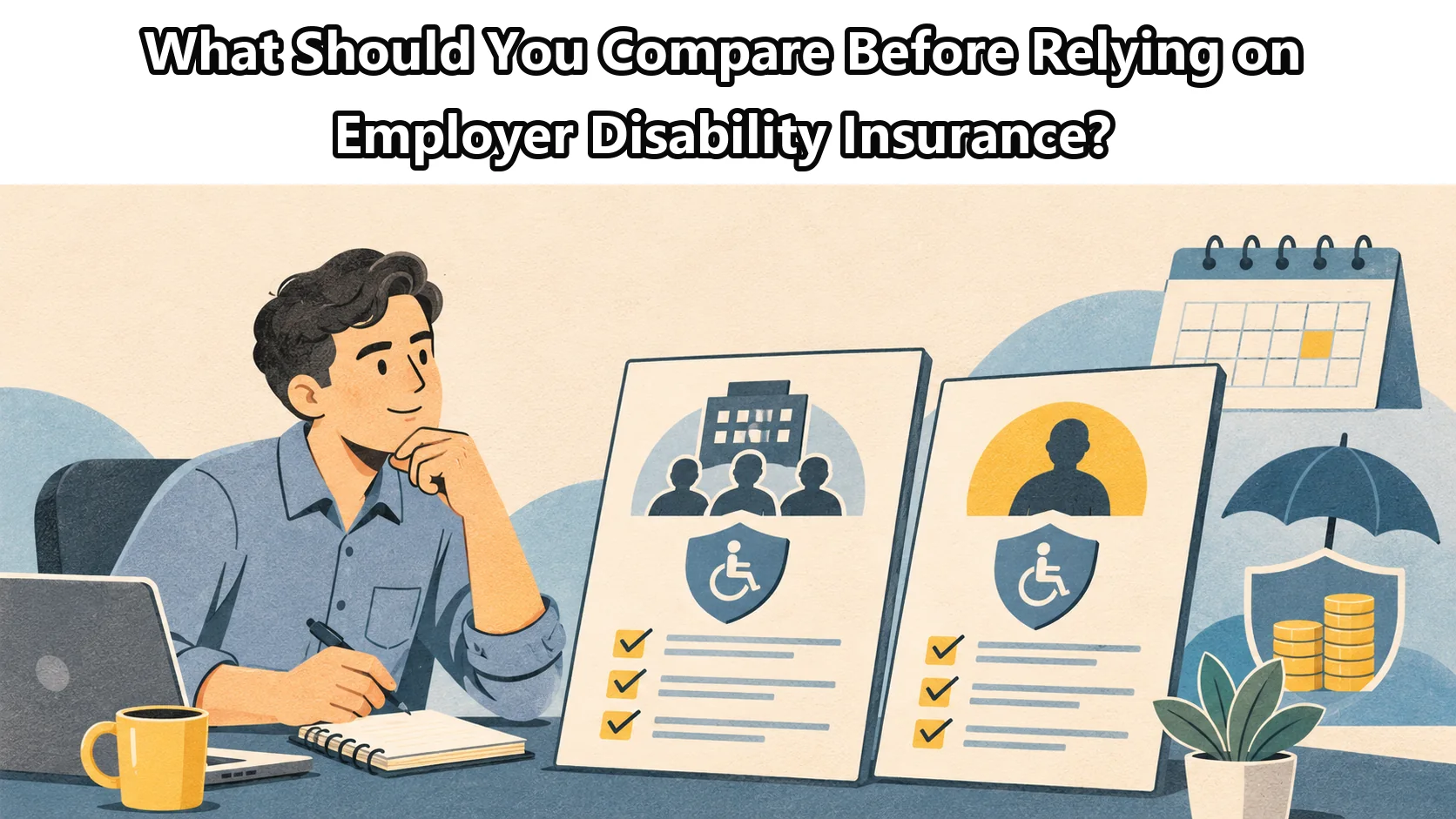
Use columns for owner, administrator, eligibility, premium payer, benefit percentage, monthly maximum, covered earnings, definition of disability, own-occupation period, elimination period, benefit period, offsets, taxes, exclusions, pre-existing rules, residual benefits, claim evidence, appeal deadlines, portability, conversion, renewal, and state availability. Leave a blank column for “document and page.”
Mark each row as confirmed, unclear, or not applicable. Request a written answer to every unclear row and save the response with the source document. This method is more reliable than ranking policies by a single percentage or relying on an online anecdote. The goal is to expose gaps before a disabling event, not to predict a future decision.
Final checklist
Before relying on employer disability insurance, locate the controlling documents and confirm what happens if you change jobs, reduce hours, take leave, receive another benefit, or return to work. Understand the disability definition, benefit amount, offsets, taxes, waiting period, maximum duration, exclusions, claim evidence, and appeal route. If any answer is missing, treat it as an open question rather than an assumption.
Then compare any individual policy separately and record its underwriting, exclusions, cost, renewability, portability, and state-specific terms. Use official plan materials and provider documents as evidence, keep dated copies, and seek qualified legal, tax, insurance, or medical advice when the decision turns on a personal contract or claim. The right next step is a documented comparison, not a promise that one coverage layer is universally best.
Sources and further reading
- disability insurance public reference — disability insurance; checked 2026-10-13.
- Guardian Individual Disability Insurance — Guardian / Berkshire Life; checked 2026-10-15.
- Guardian Disability Insurance Overview — Guardian / Berkshire Life; checked 2026-10-15.
- Assurity Disability Insurance Products — Assurity; checked 2026-10-15.
- Mutual of Omaha Employer-Based Disability Income Insurance — Mutual of Omaha; checked 2026-10-15.
- Unum Group Disability Insurance — Unum; checked 2026-10-15.
- Northwestern Mutual Disability Insurance — Northwestern Mutual; checked 2026-10-15.
- Northwestern Mutual What Is Disability Insurance? — Northwestern Mutual; checked 2026-10-15.